The hybrid SUV is now the default choice for mainstream American car buyers. In 2026, more than 40% of all SUV sales include some form of electrified powertrain — and for good reason. The math has never been clearer: today’s best hybrid SUVs deliver 36–42 mpg combined, carry MSRP premiums that pay back in 3–4 years at average fuel prices, and retain their value better than any other vehicle category. This guide ranks the best hybrid SUVs available at US dealerships in 2026, with real specs, honest pricing, and a clear recommendation for every type of buyer.
Why Hybrid SUVs Dominate the 2026 Market
Three things converged in 2026 to make the hybrid SUV the smartest buy in automotive history. First, tariffs on imported vehicles and parts have pushed new car prices up across the board — with some models seeing increases of $2,000 to $5,000 over the 2025 model year. This makes fuel savings more valuable, and hybrid payback timelines shorter. Second, Toyota converted the entire RAV4 lineup to hybrid-only for 2026, effectively removing the gas-only compact SUV option from the best-selling nameplate in America. Third, battery and motor costs have dropped enough that several 2026 hybrid SUVs are priced within $1,500–$3,000 of their gas equivalents — a gap that disappears at the pump within two to three years for typical drivers.
The result: hybrid SUVs now represent the value center of the American auto market. You don’t buy one despite the price premium — you buy one because it’s the financially rational choice.
Quick Reference: Top Hybrid SUVs of 2026
| Model | Starting MSRP | MPG Combined |
| Toyota RAV4 Hybrid | $33,350 | 42 mpg |
| Honda CR-V Hybrid | $37,080 | 40 mpg |
| Hyundai Tucson Hybrid | $32,450 | 38 mpg |
| Kia Sportage Hybrid | $30,990 | 38 mpg |
| Mazda CX-50 Hybrid | $34,750 | 38 mpg |
| Toyota Grand Highlander Hybrid | $48,970 | 34 mpg |
| Kia Sorento Hybrid | $40,335 | 34 mpg |
| Hyundai Santa Fe Hybrid | $38,650 | 38 mpg |
| Ford Escape Plug-In Hybrid | $38,900 | 42 mpg / 37 mi EV |
| Toyota RAV4 Prime (PHEV) | $42,920 | 38 mpg / 52 mi EV |
The Best Compact Hybrid SUV: Toyota RAV4 Hybrid
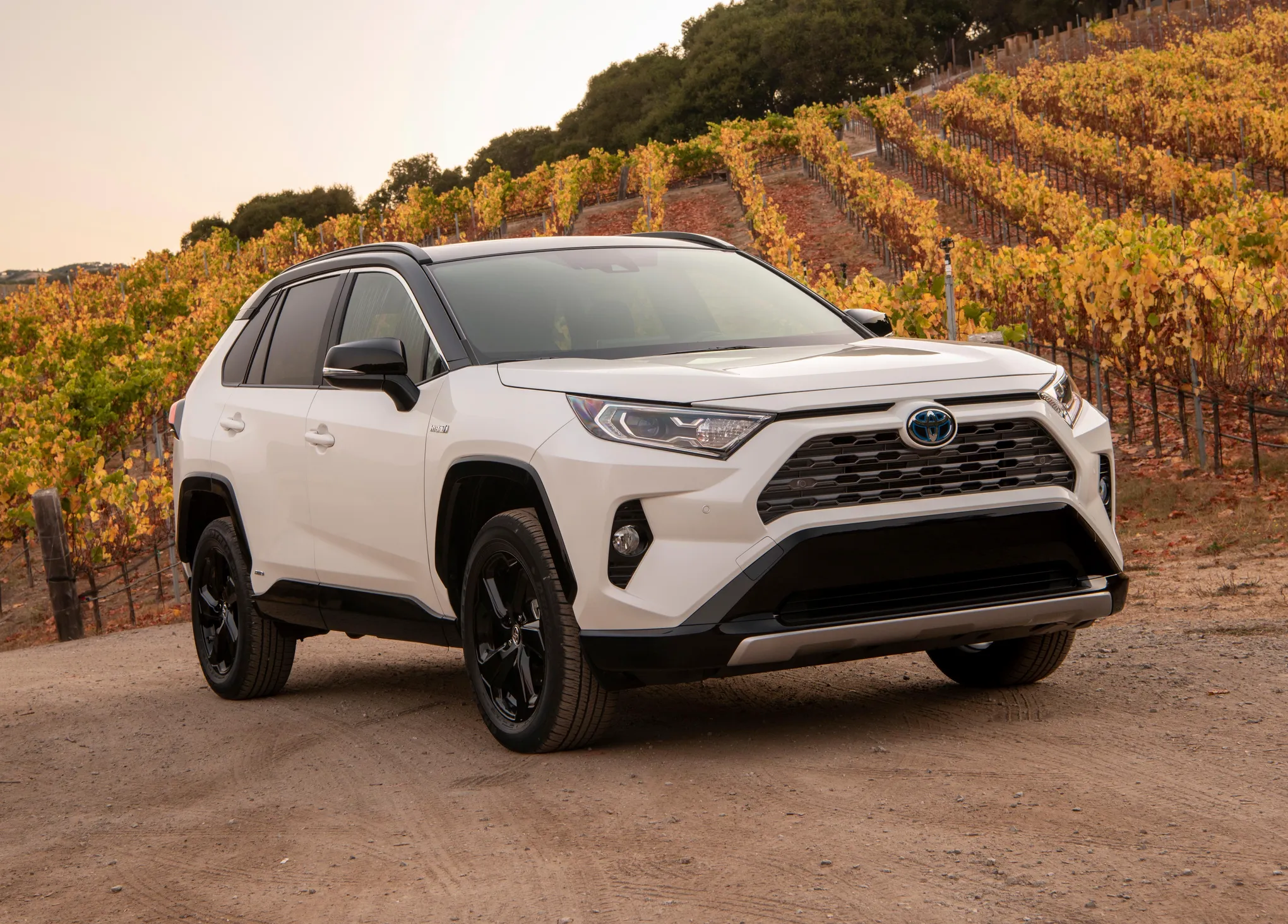
The 2026 Toyota RAV4 Hybrid isn’t just the best compact hybrid SUV — it’s arguably the best new vehicle value in America right now. Toyota went all-hybrid for the RAV4 this model year, and the result is a lineup that starts at $33,350 and delivers 42 mpg combined with standard all-wheel drive. To put that in perspective: the old gas RAV4 managed 30 mpg combined and started at $31,000. You’re paying $2,350 more for 40% better fuel efficiency and standard AWD (previously a paid upgrade).
The math works out quickly. At $3.50/gallon and 15,000 miles per year, the RAV4 Hybrid saves roughly $550 annually over its gas equivalent. Over a five-year ownership period, that’s $2,750 — effectively recovering the entire hybrid premium. Add Toyota’s legendary reliability record, the strongest dealer network in the US, and a CPO program covering 7 years/100,000 miles, and the RAV4 Hybrid is a near-perfect ownership proposition.
The 2026 update added Toyota Safety Sense 4.0 standard across all trims, a new 10.5-inch touchscreen running Toyota’s Arene platform, and a new GR Sport trim for buyers who want slightly more visual excitement from their commuter. A plug-in hybrid variant (RAV4 Prime) is also available at $42,920 with 52 miles of EV-only range.
💡 Best for: Buyers who plan to own for 5+ years, families in snow country (standard AWD is a major advantage), and anyone who wants to minimize long-term ownership cost.
Best Refined Compact Hybrid: Honda CR-V Hybrid
The Honda CR-V Hybrid starts at $37,080 — $3,730 more than the RAV4 Hybrid — but it earns the premium through a more refined driving experience and the roomiest rear cabin in the compact class. Honda’s two-motor hybrid system is genuinely smooth, without the rubber-band acceleration some CVT-based rivals produce. It also returns 40 mpg combined and tows 1,000 lbs.
New for 2026, Honda added a TrailSport Hybrid trim — the first time the CR-V has combined its adventure-oriented trim package with the hybrid powertrain. Wireless CarPlay and Android Auto are now standard across the lineup. The cargo area expands to 76.5 cubic feet with the rear seats folded, making it one of the most practical options in the segment for families with gear.
Seven years on Car and Driver’s 10Best list isn’t an accident. The CR-V Hybrid rewards long-term owners with Honda’s well-above-average reliability record and a driving experience that doesn’t feel like a compromise.
💡 Best for: Buyers prioritizing passenger space, a polished driving feel, and Honda’s reliability record over maximum fuel economy.
Best Value Compact Hybrid: Kia Sportage Hybrid
At $30,990 to start, the Kia Sportage Hybrid is the value leader of the 2026 compact hybrid field. It shares a platform and 232-horsepower hybrid system (1.6-liter turbo + six-speed automatic) with the Hyundai Tucson Hybrid, but consistently undercuts it on price by $1,500–$2,000 across equivalent trims.
What you get for the money is striking: heated and ventilated front seats, a 360-degree camera, a head-up display, and 38 mpg combined — features that cost significantly more in premium trim on competing brands. The Sportage Hybrid’s real-world fuel economy even bested the Tucson Hybrid in independent testing. The tradeoff is slightly less rear legroom and a less distinctive interior compared to its Korean sibling.
💡 Best for: Budget-conscious buyers who want maximum feature content per dollar and don’t want to compromise on efficiency.
Best Driving Dynamics: Mazda CX-50 Hybrid
If the shortlist of compact hybrid SUVs feels uniform in their efficiency-and-practicality pitch, the Mazda CX-50 Hybrid offers a different argument: it’s the most enjoyable to drive. Built on a stretched, rear-biased platform with sharper steering than any mainstream competitor, it delivers 38 mpg combined while making every drive feel deliberate and engaging.
The cabin is the other differentiator. Soft-touch surfaces, real stitching, and knurled metal controls feel closer to a $45,000 luxury vehicle than a $34,750 mainstream crossover. The Turbo Premium Plus trim pushes output to 256 horsepower with standard AWD — legitimate performance at a mainstream price. The tradeoffs are real: no three-row option, cargo space at 29.2 cubic feet behind the second row is below class average, and there’s no plug-in hybrid variant.
💡 Best for: Enthusiast buyers and couples without kids who want a premium feel and engaging dynamics over maximum utility.
Three-Row Hybrid Options: Who Wins in 2026?
Three-row hybrid SUVs graduated from niche to mainstream in 2026. Four models dominate the conversation:
Toyota Grand Highlander Hybrid — The Space King
At 97.5 cubic feet of maximum cargo and a third row that genuinely fits adults, the Grand Highlander Hybrid is the most spacious three-row hybrid available. The standard hybrid produces 245 hp and 34 mpg combined. A Hybrid MAX version pushes output to 362 hp for buyers who want performance alongside family practicality. Starting at $48,970 with standard AWD, it’s the benchmark for buyers prioritizing cargo and passenger volume.
Kia Sorento Hybrid — The Value Three-Row
At $40,335 with standard AWD and seven-passenger seating (a new second-row bench for 2026), the Sorento Hybrid is the least expensive way to get a three-row hybrid. The catch: third-row space is genuinely cramped at 12.6 cubic feet behind the row. Use the Sorento’s third row for kids; use the Grand Highlander for adults.
Hyundai Santa Fe Hybrid — The Tech Leader
The fully redesigned 2026 Santa Fe Hybrid starts at $38,650 and brings the most technology-forward interior in the mainstream segment: dual panoramic display, over-the-air updates, and a sophisticated driver assistance suite that rivals vehicles costing $20,000 more. At 38 mpg combined on the hybrid, it’s also the most fuel-efficient five-passenger mid-size option.
Should You Buy a Hybrid or a Plug-In Hybrid (PHEV) in 2026?
The choice between a standard hybrid and a plug-in hybrid comes down to one question: do you have regular access to a home charger or workplace charging?
If yes: the plug-in hybrid makes a compelling case. The Toyota RAV4 Prime at $42,920 delivers 52 miles of electric-only range — enough to cover the average American daily commute (about 30 miles round-trip) on electricity alone, then seamlessly switch to hybrid mode for longer trips. Ford’s Escape PHEV at $38,900 offers 37 miles of EV range.
If no: stick with a standard hybrid. Without regular charging, PHEVs carry a heavier battery they rarely use to full advantage, reducing their efficiency advantage over standard hybrids. The standard RAV4 Hybrid at $9,570 less is the right answer for buyers without reliable charging access.
| Your Situation | Recommended Powertrain |
| Home charger access, commute under 50 miles | Plug-in Hybrid (PHEV) |
| No home charger, mixed driving | Standard Hybrid |
| Mostly highway driving | Standard Hybrid |
| Mostly city/stop-and-go | Standard Hybrid or PHEV |
| Want maximum EV experience | Full Electric (separate guide) |
Hybrid SUV Ownership Costs: The 5-Year Math
Here’s how the fuel savings stack up for a typical buyer driving 15,000 miles per year at $3.50/gallon, comparing the hybrid to an equivalent non-hybrid:
| Model vs. Gas Equivalent | Annual Fuel Savings | 5-Year Savings |
| RAV4 Hybrid vs. RAV4 gas | ~$550/year | ~$2,750 |
| CR-V Hybrid vs. CR-V gas | ~$490/year | ~$2,450 |
| Tucson Hybrid vs. Tucson gas | ~$510/year | ~$2,550 |
| Grand Highlander Hybrid vs. gas | ~$849/year | ~$4,245 |
These numbers only account for fuel. Add in the lower brake wear (regenerative braking reduces pad replacement frequency significantly on hybrids) and the proven resale value premium that hybrid models command in the used car market, and the total ownership case is even stronger.
Bottom Line: Which Hybrid SUV Should You Buy?
For most American buyers, the 2026 Toyota RAV4 Hybrid is the safest, most financially sound choice in the segment. Standard AWD, 42 mpg, $33,350 starting price, and Toyota’s reliability record combine into an offer that’s genuinely hard to argue against.
If the RAV4’s slightly higher interior noise level or dated tech bothers you, the Honda CR-V Hybrid at $37,080 delivers a more refined cabin and driving experience that justifies the premium for buyers who care about those things.
If budget is the primary driver, the Kia Sportage Hybrid at $30,990 offers almost everything the Tucson provides at $1,500+ less.
Whatever you choose, you’re buying at arguably the peak moment for hybrid technology maturity and value in American automotive history. The engineering is proven, the prices are competitive, and the savings are real.